Примечание.
Для доступа к этой странице требуется авторизация. Вы можете попробовать войти или изменить каталоги.
Для доступа к этой странице требуется авторизация. Вы можете попробовать изменить каталоги.
Журналы контейнеров кластеров Kubernetes собирают метрики производительности, данные о ресурсах и информацию о состоянии из контейнерных узлов и контейнеров. Данные хранятся в рабочей области Log Analytics, где она доступна для запросов журналов с помощью Log Analytics в Azure Monitor.
Эти данные полезны для сценариев, которые включают планирование миграции, анализ емкости, обнаружение и устранение неполадок производительности по запросу. Запросы журналов с помощью этих данных помогают искать тенденции, диагностировать узкие места, прогнозировать или сопоставлять данные, которые помогут определить, выполняется ли текущая конфигурация кластера оптимально.
Сведения о том, как использовать эти запросы, см. в статье Использование запросов в Azure Monitor Log Analytics. Полное руководство по использованию Log Analytics для выполнения запросов и работы с их результатами см. в учебном пособии по работе с Log Analytics.
Внимание
Если вы изменили параметры сбора данных по умолчанию, запросы могут не возвращать ожидаемые результаты. В первую очередь, если вы не собираете данные о производительности из кластера, так как это избыточно, все запросы, использующие таблицу Perf , не возвращают результаты.
Сведения о настройке сбора данных в службе "Аналитика контейнеров" с помощью правила сбора данных для предварительно настроенных конфигураций, включая отключение сбора данных о производительности. Дополнительные параметры сбора данных см. в статье "Настройка сбора данных в аналитике контейнеров" с помощью ConfigMap .
Открытие Log Analytics
Область сеанса Log Analytics зависит от того, как его запустить. Для доступа ко всем данным в рабочей области выберите "Журналы " в меню "Монитор " на портале Azure. Чтобы ограничить данные до одного кластера Kubernetes, выберите Журналы в меню этого кластера.
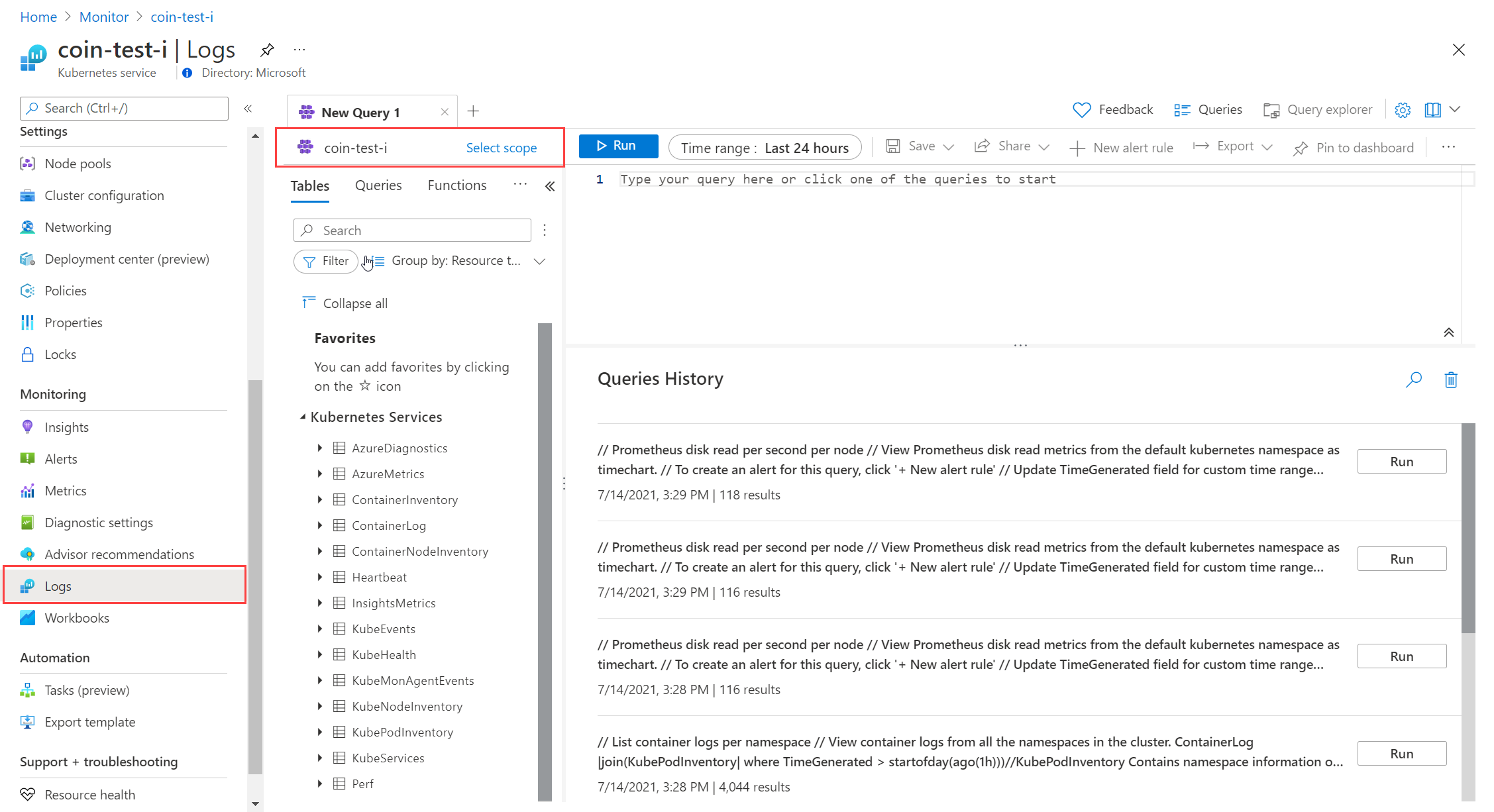
Существующие запросы к журналам
Вам не обязательно нужно понять, как написать запрос журнала для использования Log Analytics, а вместо этого выбрать из нескольких предварительно созданных запросов. Вы можете запускать эти запросы без изменений или взять их за основу для создания собственных. Выберите Запросы в верхней части экрана Log Analytics и просмотрите запросы с типом ресурсаСлужбы Kubernetes.

Таблицы контейнеров
Список таблиц с подробными описаниями, используемыми службой аналитики контейнеров, представлен в справочнике по таблицам Azure Monitor. Все эти таблицы доступны для запросов к журналам.
Пример запросов журнала
При создании запросов часто бывает полезно начать с одного-двух примеров, внося затем в них изменения в соответствии со своими требованиями. Можно поэкспериментировать с приведенными ниже примерами запросов, чтобы научиться создавать более сложные запросы.
Вывод всех сведений о жизненном цикле контейнера
ContainerInventory
| project Computer, Name, Image, ImageTag, ContainerState, CreatedTime, StartedTime, FinishedTime
| render table
События Kubernetes
Примечание.
По умолчанию обычные типы событий не собираются, поэтому вы не увидите их при запросе таблицы KubeEvents, если параметр collect_all_kube_events ConfigMap не включен. Если необходимо собрать стандартные события, включите настройку collect_all_kube_events в ConfigMap container-azm-ms-agentconfig. Сведения о настройке конфигурации ConfigMap см. в статье "Настройка сбора данных агента для аналитики контейнеров ".
KubeEvents
| where not(isempty(Namespace))
| sort by TimeGenerated desc
| render table
Количество запросов в минуту с пользовательскими метриками
InsightsMetrics
| where Name == "requests_count"
| summarize Val=any(Val) by TimeGenerated=bin(TimeGenerated, 1m)
| sort by TimeGenerated asc
| project RequestsPerMinute = Val - prev(Val), TimeGenerated
| render barchart
Модули pod по имени и пространству имен
let startTimestamp = ago(1h);
KubePodInventory
| where TimeGenerated > startTimestamp
| project ContainerID, PodName=Name, Namespace
| where PodName contains "name" and Namespace startswith "namespace"
| distinct ContainerID, PodName
| join
(
    ContainerLog
    | where TimeGenerated > startTimestamp
)
on ContainerID
// at this point before the next pipe, columns from both tables are available to be "projected". Due to both
// tables having a "Name" column, we assign an alias as PodName to one column which we actually want
| project TimeGenerated, PodName, LogEntry, LogEntrySource
| summarize by TimeGenerated, LogEntry
| order by TimeGenerated desc
Горизонтальное увеличение масштаба модулей pod (HPA)
Этот запрос возвращает количество горизонтально масштабированных реплик в каждом развертывании. Он вычисляет процент масштабирования с учетом максимального количества реплик, заданных в HPA (Horizontal Pod Autoscaler).
let _minthreshold = 70; // minimum threshold goes here if you want to setup as an alert
let _maxthreshold = 90; // maximum threshold goes here if you want to setup as an alert
let startDateTime = ago(60m);
KubePodInventory
| where TimeGenerated >= startDateTime
| where Namespace !in('default', 'kube-system') // List of non system namespace filter goes here.
| extend labels = todynamic(PodLabel)
| extend deployment_hpa = reverse(substring(reverse(ControllerName), indexof(reverse(ControllerName), "-") + 1))
| distinct tostring(deployment_hpa)
| join kind=inner (InsightsMetrics
    | where TimeGenerated > startDateTime
    | where Name == 'kube_hpa_status_current_replicas'
    | extend pTags = todynamic(Tags) //parse the tags for values
    | extend ns = todynamic(pTags.k8sNamespace) //parse namespace value from tags
    | extend deployment_hpa = todynamic(pTags.targetName) //parse HPA target name from tags
    | extend max_reps = todynamic(pTags.spec_max_replicas) // Parse maximum replica settings from HPA deployment
    | extend desired_reps = todynamic(pTags.status_desired_replicas) // Parse desired replica settings from HPA deployment
    | summarize arg_max(TimeGenerated, *) by tostring(ns), tostring(deployment_hpa), Cluster=toupper(tostring(split(_ResourceId, '/')[8])), toint(desired_reps), toint(max_reps), scale_out_percentage=(desired_reps * 100 / max_reps)
    //| where scale_out_percentage > _minthreshold and scale_out_percentage <= _maxthreshold
    )
    on deployment_hpa
Масштабирование пула узлов
Этот запрос возвращает количество активных узлов в каждом пуле узлов. Он вычисляет количество доступных активных узлов и конфигурацию максимального количества узлов в параметрах автоматического масштабирования, чтобы определить процент горизонтального увеличения масштаба. Если вы хотите использовать запрос для правила генерации оповещений Количество результатов, обратите внимание на закомментированные строки.
let nodepoolMaxnodeCount = 10; // the maximum number of nodes in your auto scale setting goes here.
let _minthreshold = 20;
let _maxthreshold = 90;
let startDateTime = 60m;
KubeNodeInventory
| where TimeGenerated >= ago(startDateTime)
| extend nodepoolType = todynamic(Labels) //Parse the labels to get the list of node pool types
| extend nodepoolName = todynamic(nodepoolType[0].agentpool) // parse the label to get the nodepool name or set the specific nodepool name (like nodepoolName = 'agentpool)'
| summarize nodeCount = count(Computer) by ClusterName, tostring(nodepoolName), TimeGenerated
//(Uncomment the below two lines to set this as a log search alert)
//| extend scaledpercent = iff(((nodeCount * 100 / nodepoolMaxnodeCount) >= _minthreshold and (nodeCount * 100 / nodepoolMaxnodeCount) < _maxthreshold), "warn", "normal")
//| where scaledpercent == 'warn'
| summarize arg_max(TimeGenerated, *) by nodeCount, ClusterName, tostring(nodepoolName)
| project ClusterName,
    TotalNodeCount= strcat("Total Node Count: ", nodeCount),
    ScaledOutPercentage = (nodeCount * 100 / nodepoolMaxnodeCount),
    TimeGenerated,
    nodepoolName
Доступность системных контейнеров (РепликаСет)
Этот запрос выдает системные контейнеры (наборы реплик) и отображает процент недоступных. Если вы хотите использовать запрос для правила генерации оповещений Количество результатов, обратите внимание на закомментированные строки.
let startDateTime = 5m; // the minimum time interval goes here
let _minalertThreshold = 50; //Threshold for minimum and maximum unavailable or not running containers
let _maxalertThreshold = 70;
KubePodInventory
| where TimeGenerated >= ago(startDateTime)
| distinct ClusterName, TimeGenerated
| summarize Clustersnapshot = count() by ClusterName
| join kind=inner (
    KubePodInventory
    | where TimeGenerated >= ago(startDateTime)
    | where Namespace in('default', 'kube-system') and ControllerKind == 'ReplicaSet' // the system namespace filter goes here
    | distinct ClusterName, Computer, PodUid, TimeGenerated, PodStatus, ServiceName, PodLabel, Namespace, ContainerStatus
    | summarize arg_max(TimeGenerated, *), TotalPODCount = count(), podCount = sumif(1, PodStatus == 'Running' or PodStatus != 'Running'), containerNotrunning = sumif(1, ContainerStatus != 'running')
        by ClusterName, TimeGenerated, ServiceName, PodLabel, Namespace
    )
    on ClusterName
| project ClusterName, ServiceName, podCount, containerNotrunning, containerNotrunningPercent = (containerNotrunning * 100 / podCount), TimeGenerated, PodStatus, PodLabel, Namespace, Environment = tostring(split(ClusterName, '-')[3]), Location = tostring(split(ClusterName, '-')[4]), ContainerStatus
//Uncomment the below line to set for automated alert
//| where PodStatus == "Running" and containerNotrunningPercent > _minalertThreshold and containerNotrunningPercent < _maxalertThreshold
| summarize arg_max(TimeGenerated, *), c_entry=count() by PodLabel, ServiceName, ClusterName
//Below lines are to parse the labels to identify the impacted service/component name
| extend parseLabel = replace(@'k8s-app', @'k8sapp', PodLabel)
| extend parseLabel = replace(@'app.kubernetes.io\\/component', @'appkubernetesiocomponent', parseLabel)
| extend parseLabel = replace(@'app.kubernetes.io\\/instance', @'appkubernetesioinstance', parseLabel)
| extend tags = todynamic(parseLabel)
| extend tag01 = todynamic(tags[0].app)
| extend tag02 = todynamic(tags[0].k8sapp)
| extend tag03 = todynamic(tags[0].appkubernetesiocomponent)
| extend tag04 = todynamic(tags[0].aadpodidbinding)
| extend tag05 = todynamic(tags[0].appkubernetesioinstance)
| extend tag06 = todynamic(tags[0].component)
| project ClusterName, TimeGenerated,
    ServiceName = strcat( ServiceName, tag01, tag02, tag03, tag04, tag05, tag06),
    ContainerUnavailable = strcat("Unavailable Percentage: ", containerNotrunningPercent),
    PodStatus = strcat("PodStatus: ", PodStatus),
    ContainerStatus = strcat("Container Status: ", ContainerStatus)
Доступность системных контейнеров (наборов управляющих программ)
Этот запрос возвращает системные контейнеры (наборы управляющих программ) и сообщает процент недоступных. Если вы хотите использовать запрос для правила генерации оповещений Количество результатов, обратите внимание на закомментированные строки.
let startDateTime = 5m; // the minimum time interval goes here
let _minalertThreshold = 50; //Threshold for minimum and maximum unavailable or not running containers
let _maxalertThreshold = 70;
KubePodInventory
| where TimeGenerated >= ago(startDateTime)
| distinct ClusterName, TimeGenerated
| summarize Clustersnapshot = count() by ClusterName
| join kind=inner (
    KubePodInventory
    | where TimeGenerated >= ago(startDateTime)
    | where Namespace in('default', 'kube-system') and ControllerKind == 'DaemonSet' // the system namespace filter goes here
    | distinct ClusterName, Computer, PodUid, TimeGenerated, PodStatus, ServiceName, PodLabel, Namespace, ContainerStatus
    | summarize arg_max(TimeGenerated, *), TotalPODCount = count(), podCount = sumif(1, PodStatus == 'Running' or PodStatus != 'Running'), containerNotrunning = sumif(1, ContainerStatus != 'running')
        by ClusterName, TimeGenerated, ServiceName, PodLabel, Namespace
    )
    on ClusterName
| project ClusterName, ServiceName, podCount, containerNotrunning, containerNotrunningPercent = (containerNotrunning * 100 / podCount), TimeGenerated, PodStatus, PodLabel, Namespace, Environment = tostring(split(ClusterName, '-')[3]), Location = tostring(split(ClusterName, '-')[4]), ContainerStatus
//Uncomment the below line to set for automated alert
//| where PodStatus == "Running" and containerNotrunningPercent > _minalertThreshold and containerNotrunningPercent < _maxalertThreshold
| summarize arg_max(TimeGenerated, *), c_entry=count() by PodLabel, ServiceName, ClusterName
//Below lines are to parse the labels to identify the impacted service/component name
| extend parseLabel = replace(@'k8s-app', @'k8sapp', PodLabel)
| extend parseLabel = replace(@'app.kubernetes.io\\/component', @'appkubernetesiocomponent', parseLabel)
| extend parseLabel = replace(@'app.kubernetes.io\\/instance', @'appkubernetesioinstance', parseLabel)
| extend tags = todynamic(parseLabel)
| extend tag01 = todynamic(tags[0].app)
| extend tag02 = todynamic(tags[0].k8sapp)
| extend tag03 = todynamic(tags[0].appkubernetesiocomponent)
| extend tag04 = todynamic(tags[0].aadpodidbinding)
| extend tag05 = todynamic(tags[0].appkubernetesioinstance)
| extend tag06 = todynamic(tags[0].component)
| project ClusterName, TimeGenerated,
    ServiceName = strcat( ServiceName, tag01, tag02, tag03, tag04, tag05, tag06),
    ContainerUnavailable = strcat("Unavailable Percentage: ", containerNotrunningPercent),
    PodStatus = strcat("PodStatus: ", PodStatus),
    ContainerStatus = strcat("Container Status: ", ContainerStatus)
Журналы контейнеров
Журналы контейнеров для AKS хранятся в таблице ContainerLogV2. Вы можете выполнить следующие примеры запросов, чтобы найти выходные данные журнала stderr/stdout из целевых модулей, развертываний или пространств имен.
Журналы контейнеров для конкретного pod, пространства имен и контейнера
ContainerLogV2
| where _ResourceId =~ "clusterResourceID" //update with resource ID
| where PodNamespace == "podNameSpace" //update with target namespace
| where PodName == "podName" //update with target pod
| where ContainerName == "containerName" //update with target container
| project TimeGenerated, Computer, ContainerId, LogMessage, LogSource
Журналы контейнеров для определенного развертывания
let startDateTime = datetime('start time'); //start time format: YYYY-MM-DD HH:MM:SS
let endDateTime = datetime('end time'); //end time format: YYYY-MM-DD HH:MM:SS
let KubePodInv = KubePodInventory
| where _ResourceId =~ "clusterResourceID" //update with resource ID
| where Namespace == "deploymentNamespace" //update with target namespace
| where ControllerKind == "ReplicaSet"
| extend deployment = reverse(substring(reverse(ControllerName), indexof(reverse(ControllerName), "-") + 1))
| where deployment == "deploymentName" //update with target deployment
| extend ContainerId = ContainerID
| summarize arg_max(TimeGenerated, *)  by deployment, ContainerId, PodStatus, ContainerStatus
| project deployment, ContainerId, PodStatus, ContainerStatus;
KubePodInv
| join
(
    ContainerLogV2
  | where TimeGenerated >= startDateTime and TimeGenerated < endDateTime
  | where PodNamespace == "deploymentNamespace" //update with target namespace
  | where PodName startswith "deploymentName" //update with target deployment
) on ContainerId
| project TimeGenerated, deployment, PodName, PodStatus, ContainerName, ContainerId, ContainerStatus, LogMessage, LogSource
Журналы контейнеров для любых неудавшихся pod'ов в конкретном пространстве имен.
    let startDateTime = datetime('start time'); //start time format: YYYY-MM-DD HH:MM:SS
    let endDateTime = datetime('end time'); //end time format: YYYY-MM-DD HH:MM:SS
    let KubePodInv = KubePodInventory
    | where TimeGenerated >= startDateTime and TimeGenerated < endDateTime
    | where _ResourceId =~ "clustereResourceID" //update with resource ID
    | where Namespace == "podNamespace" //update with target namespace
    | where PodStatus == "Failed"
    | extend ContainerId = ContainerID
    | summarize arg_max(TimeGenerated, *)  by  ContainerId, PodStatus, ContainerStatus
    | project ContainerId, PodStatus, ContainerStatus;
    KubePodInv
    | join
    (
        ContainerLogV2
    | where TimeGenerated >= startDateTime and TimeGenerated < endDateTime
    | where PodNamespace == "podNamespace" //update with target namespace
    ) on ContainerId
    | project TimeGenerated, PodName, PodStatus, ContainerName, ContainerId, ContainerStatus, LogMessage, LogSource
Запросы визуализации по умолчанию для аналитики контейнеров
Эти запросы создаются из готовых визуализаций аналитики контейнеров. Вы можете использовать их, если вы включили настраиваемые параметры оптимизации затрат, вместо диаграмм по умолчанию.
Количество узлов по состоянию
Необходимые таблицы для этой диаграммы включают KubeNodeInventory.
 let trendBinSize = 5m;
 let maxListSize = 1000;
 let clusterId = 'clusterResourceID'; //update with resource ID
 let rawData = KubeNodeInventory
| where ClusterId =~ clusterId
| distinct ClusterId, TimeGenerated
| summarize ClusterSnapshotCount = count() by Timestamp = bin(TimeGenerated, trendBinSize), ClusterId
| join hint.strategy=broadcast ( KubeNodeInventory
| where ClusterId =~ clusterId
| summarize TotalCount = count(), ReadyCount = sumif(1, Status contains ('Ready')) by ClusterId, Timestamp = bin(TimeGenerated, trendBinSize)
| extend NotReadyCount = TotalCount - ReadyCount ) on ClusterId, Timestamp
| project ClusterId, Timestamp, TotalCount = todouble(TotalCount) / ClusterSnapshotCount, ReadyCount = todouble(ReadyCount) / ClusterSnapshotCount, NotReadyCount = todouble(NotReadyCount) / ClusterSnapshotCount;
 rawData
| order by Timestamp asc
| summarize makelist(Timestamp, maxListSize), makelist(TotalCount, maxListSize), makelist(ReadyCount, maxListSize), makelist(NotReadyCount, maxListSize) by ClusterId
| join ( rawData
| summarize Avg_TotalCount = avg(TotalCount), Avg_ReadyCount = avg(ReadyCount), Avg_NotReadyCount = avg(NotReadyCount) by ClusterId ) on ClusterId
| project ClusterId, Avg_TotalCount, Avg_ReadyCount, Avg_NotReadyCount, list_Timestamp, list_TotalCount, list_ReadyCount, list_NotReadyCount
Количество Pod по состоянию
Необходимые таблицы для этой диаграммы включают KubePodInventory.
 let trendBinSize = 5m;
 let maxListSize = 1000;
 let clusterId = 'clusterResourceID'; //update with resource ID
 let rawData = KubePodInventory
| where ClusterId =~ clusterId
| distinct ClusterId, TimeGenerated
| summarize ClusterSnapshotCount = count() by bin(TimeGenerated, trendBinSize), ClusterId
| join hint.strategy=broadcast ( KubePodInventory
| where ClusterId =~ clusterId
| summarize PodStatus=any(PodStatus) by TimeGenerated, PodUid, ClusterId
| summarize TotalCount = count(), PendingCount = sumif(1, PodStatus =~ 'Pending'), RunningCount = sumif(1, PodStatus =~ 'Running'), SucceededCount = sumif(1, PodStatus =~ 'Succeeded'), FailedCount = sumif(1, PodStatus =~ 'Failed'), TerminatingCount = sumif(1, PodStatus =~ 'Terminating') by ClusterId, bin(TimeGenerated, trendBinSize) ) on ClusterId, TimeGenerated
| extend UnknownCount = TotalCount - PendingCount - RunningCount - SucceededCount - FailedCount - TerminatingCount
| project ClusterId, Timestamp = TimeGenerated, TotalCount = todouble(TotalCount) / ClusterSnapshotCount, PendingCount = todouble(PendingCount) / ClusterSnapshotCount, RunningCount = todouble(RunningCount) / ClusterSnapshotCount, SucceededCount = todouble(SucceededCount) / ClusterSnapshotCount, FailedCount = todouble(FailedCount) / ClusterSnapshotCount, TerminatingCount = todouble(TerminatingCount) / ClusterSnapshotCount, UnknownCount = todouble(UnknownCount) / ClusterSnapshotCount;
 let rawDataCached = rawData;
 rawDataCached
| order by Timestamp asc
| summarize makelist(Timestamp, maxListSize), makelist(TotalCount, maxListSize), makelist(PendingCount, maxListSize), makelist(RunningCount, maxListSize), makelist(SucceededCount, maxListSize), makelist(FailedCount, maxListSize), makelist(TerminatingCount, maxListSize), makelist(UnknownCount, maxListSize) by ClusterId
| join ( rawDataCached
| summarize Avg_TotalCount = avg(TotalCount), Avg_PendingCount = avg(PendingCount), Avg_RunningCount = avg(RunningCount), Avg_SucceededCount = avg(SucceededCount), Avg_FailedCount = avg(FailedCount), Avg_TerminatingCount = avg(TerminatingCount), Avg_UnknownCount = avg(UnknownCount) by ClusterId ) on ClusterId
| project ClusterId, Avg_TotalCount, Avg_PendingCount, Avg_RunningCount, Avg_SucceededCount, Avg_FailedCount, Avg_TerminatingCount, Avg_UnknownCount, list_Timestamp, list_TotalCount, list_PendingCount, list_RunningCount, list_SucceededCount, list_FailedCount, list_TerminatingCount, list_UnknownCount
Список контейнеров по состоянию
Необходимые таблицы для этой диаграммы включают KubePodInventory и Perf.
 let startDateTime = datetime('start time'); //start time format: YYYY-MM-DD HH:MM:SS
 let endDateTime = datetime('end time'); //end time format: YYYY-MM-DD HH:MM:SS
 let trendBinSize = 15m;
 let maxResultCount = 10000;
 let metricUsageCounterName = 'cpuUsageNanoCores';
 let metricLimitCounterName = 'cpuLimitNanoCores';
 let KubePodInventoryTable = KubePodInventory
| where TimeGenerated >= startDateTime
| where TimeGenerated < endDateTime
| where isnotempty(ClusterName)
| where isnotempty(Namespace)
| where isnotempty(Computer)
| project TimeGenerated, ClusterId, ClusterName, Namespace, ServiceName, ControllerName, Node = Computer, Pod = Name, ContainerInstance = ContainerName, ContainerID, ReadySinceNow = format_timespan(endDateTime - ContainerCreationTimeStamp , 'ddd.hh:mm:ss.fff'), Restarts = ContainerRestartCount, Status = ContainerStatus, ContainerStatusReason = columnifexists('ContainerStatusReason', ''), ControllerKind = ControllerKind, PodStatus;
 let startRestart = KubePodInventoryTable
| summarize arg_min(TimeGenerated, *) by Node, ContainerInstance
| where ClusterId =~ 'clusterResourceID' //update with resource ID
| project Node, ContainerInstance, InstanceName = strcat(ClusterId, '/', ContainerInstance), StartRestart = Restarts;
 let IdentityTable = KubePodInventoryTable
| summarize arg_max(TimeGenerated, *) by Node, ContainerInstance
| where ClusterId =~ 'clusterResourceID' //update with resource ID
| project ClusterName, Namespace, ServiceName, ControllerName, Node, Pod, ContainerInstance, InstanceName = strcat(ClusterId, '/', ContainerInstance), ContainerID, ReadySinceNow, Restarts, Status = iff(Status =~ 'running', 0, iff(Status=~'waiting', 1, iff(Status =~'terminated', 2, 3))), ContainerStatusReason, ControllerKind, Containers = 1, ContainerName = tostring(split(ContainerInstance, '/')[1]), PodStatus, LastPodInventoryTimeGenerated = TimeGenerated, ClusterId;
 let CachedIdentityTable = IdentityTable;
 let FilteredPerfTable = Perf
| where TimeGenerated >= startDateTime
| where TimeGenerated < endDateTime
| where ObjectName == 'K8SContainer'
| where InstanceName startswith 'clusterResourceID'
| project Node = Computer, TimeGenerated, CounterName, CounterValue, InstanceName ;
 let CachedFilteredPerfTable = FilteredPerfTable;
 let LimitsTable = CachedFilteredPerfTable
| where CounterName =~ metricLimitCounterName
| summarize arg_max(TimeGenerated, *) by Node, InstanceName
| project Node, InstanceName, LimitsValue = iff(CounterName =~ 'cpuLimitNanoCores', CounterValue/1000000, CounterValue), TimeGenerated;
 let MetaDataTable = CachedIdentityTable
| join kind=leftouter ( LimitsTable ) on Node, InstanceName
| join kind= leftouter ( startRestart ) on Node, InstanceName
| project ClusterName, Namespace, ServiceName, ControllerName, Node, Pod, InstanceName, ContainerID, ReadySinceNow, Restarts, LimitsValue, Status, ContainerStatusReason = columnifexists('ContainerStatusReason', ''), ControllerKind, Containers, ContainerName, ContainerInstance, StartRestart, PodStatus, LastPodInventoryTimeGenerated, ClusterId;
 let UsagePerfTable = CachedFilteredPerfTable
| where CounterName =~ metricUsageCounterName
| project TimeGenerated, Node, InstanceName, CounterValue = iff(CounterName =~ 'cpuUsageNanoCores', CounterValue/1000000, CounterValue);
 let LastRestartPerfTable = CachedFilteredPerfTable
| where CounterName =~ 'restartTimeEpoch'
| summarize arg_max(TimeGenerated, *) by Node, InstanceName
| project Node, InstanceName, UpTime = CounterValue, LastReported = TimeGenerated;
 let AggregationTable = UsagePerfTable
| summarize Aggregation = max(CounterValue) by Node, InstanceName
| project Node, InstanceName, Aggregation;
 let TrendTable = UsagePerfTable
| summarize TrendAggregation = max(CounterValue) by bin(TimeGenerated, trendBinSize), Node, InstanceName
| project TrendTimeGenerated = TimeGenerated, Node, InstanceName , TrendAggregation
| summarize TrendList = makelist(pack("timestamp", TrendTimeGenerated, "value", TrendAggregation)) by Node, InstanceName;
 let containerFinalTable = MetaDataTable
| join kind= leftouter( AggregationTable ) on Node, InstanceName
| join kind = leftouter (LastRestartPerfTable) on Node, InstanceName
| order by Aggregation desc, ContainerName
| join kind = leftouter ( TrendTable) on Node, InstanceName
| extend ContainerIdentity = strcat(ContainerName, ' ', Pod)
| project ContainerIdentity, Status, ContainerStatusReason = columnifexists('ContainerStatusReason', ''), Aggregation, Node, Restarts, ReadySinceNow, TrendList = iif(isempty(TrendList), parse_json('[]'), TrendList), LimitsValue, ControllerName, ControllerKind, ContainerID, Containers, UpTimeNow = datetime_diff('Millisecond', endDateTime, datetime_add('second', toint(UpTime), make_datetime(1970,1,1))), ContainerInstance, StartRestart, LastReportedDelta = datetime_diff('Millisecond', endDateTime, LastReported), PodStatus, InstanceName, Namespace, LastPodInventoryTimeGenerated, ClusterId;
containerFinalTable
| limit 200
Список контроллеров по статусу
Необходимые таблицы для этой диаграммы включают KubePodInventory и Perf.
 let endDateTime = datetime('start time'); //start time format: YYYY-MM-DD HH:MM:SS
 let startDateTime = datetime('end time'); //end time format: YYYY-MM-DD HH:MM:SS
 let trendBinSize = 15m;
 let metricLimitCounterName = 'cpuLimitNanoCores';
 let metricUsageCounterName = 'cpuUsageNanoCores';
 let primaryInventory = KubePodInventory
| where TimeGenerated >= startDateTime
| where TimeGenerated < endDateTime
| where isnotempty(ClusterName)
| where isnotempty(Namespace)
| extend Node = Computer
| where ClusterId =~ 'clusterResourceID' //update with resource ID
| project TimeGenerated, ClusterId, ClusterName, Namespace, ServiceName, Node = Computer, ControllerName, Pod = Name, ContainerInstance = ContainerName, ContainerID, InstanceName, PerfJoinKey = strcat(ClusterId, '/', ContainerName), ReadySinceNow = format_timespan(endDateTime - ContainerCreationTimeStamp, 'ddd.hh:mm:ss.fff'), Restarts = ContainerRestartCount, Status = ContainerStatus, ContainerStatusReason = columnifexists('ContainerStatusReason', ''), ControllerKind = ControllerKind, PodStatus, ControllerId = strcat(ClusterId, '/', Namespace, '/', ControllerName);
let podStatusRollup = primaryInventory
| summarize arg_max(TimeGenerated, *) by Pod
| project ControllerId, PodStatus, TimeGenerated
| summarize count() by ControllerId, PodStatus = iif(TimeGenerated < ago(30m), 'Unknown', PodStatus)
| summarize PodStatusList = makelist(pack('Status', PodStatus, 'Count', count_)) by ControllerId;
let latestContainersByController = primaryInventory
| where isnotempty(Node)
| summarize arg_max(TimeGenerated, *) by PerfJoinKey
| project ControllerId, PerfJoinKey;
let filteredPerformance = Perf
| where TimeGenerated >= startDateTime
| where TimeGenerated < endDateTime
| where ObjectName == 'K8SContainer'
| where InstanceName startswith 'clusterResourceID' //update with resource ID
| project TimeGenerated, CounterName, CounterValue, InstanceName, Node = Computer ;
let metricByController = filteredPerformance
| where CounterName =~ metricUsageCounterName
| extend PerfJoinKey = InstanceName
| summarize Value = percentile(CounterValue, 95) by PerfJoinKey, CounterName
| join (latestContainersByController) on PerfJoinKey
| summarize Value = sum(Value) by ControllerId, CounterName
| project ControllerId, CounterName, AggregationValue = iff(CounterName =~ 'cpuUsageNanoCores', Value/1000000, Value);
let containerCountByController = latestContainersByController
| summarize ContainerCount = count() by ControllerId;
let restartCountsByController = primaryInventory
| summarize Restarts = max(Restarts) by ControllerId;
let oldestRestart = primaryInventory
| summarize ReadySinceNow = min(ReadySinceNow) by ControllerId;
let trendLineByController = filteredPerformance
| where CounterName =~ metricUsageCounterName
| extend PerfJoinKey = InstanceName
| summarize Value = percentile(CounterValue, 95) by bin(TimeGenerated, trendBinSize), PerfJoinKey, CounterName
| order by TimeGenerated asc
| join kind=leftouter (latestContainersByController) on PerfJoinKey
| summarize Value=sum(Value) by ControllerId, TimeGenerated, CounterName
| project TimeGenerated, Value = iff(CounterName =~ 'cpuUsageNanoCores', Value/1000000, Value), ControllerId
| summarize TrendList = makelist(pack("timestamp", TimeGenerated, "value", Value)) by ControllerId;
let latestLimit = filteredPerformance
| where CounterName =~ metricLimitCounterName
| extend PerfJoinKey = InstanceName
| summarize arg_max(TimeGenerated, *) by PerfJoinKey
| join kind=leftouter (latestContainersByController) on PerfJoinKey
| summarize Value = sum(CounterValue) by ControllerId, CounterName
| project ControllerId, LimitValue = iff(CounterName =~ 'cpuLimitNanoCores', Value/1000000, Value);
let latestTimeGeneratedByController = primaryInventory
| summarize arg_max(TimeGenerated, *) by ControllerId
| project ControllerId, LastTimeGenerated = TimeGenerated;
primaryInventory
| distinct ControllerId, ControllerName, ControllerKind, Namespace
| join kind=leftouter (podStatusRollup) on ControllerId
| join kind=leftouter (metricByController) on ControllerId
| join kind=leftouter (containerCountByController) on ControllerId
| join kind=leftouter (restartCountsByController) on ControllerId
| join kind=leftouter (oldestRestart) on ControllerId
| join kind=leftouter (trendLineByController) on ControllerId
| join kind=leftouter (latestLimit) on ControllerId
| join kind=leftouter (latestTimeGeneratedByController) on ControllerId
| project ControllerId, ControllerName, ControllerKind, PodStatusList, AggregationValue, ContainerCount = iif(isempty(ContainerCount), 0, ContainerCount), Restarts, ReadySinceNow, Node = '-', TrendList, LimitValue, LastTimeGenerated, Namespace
| limit 250;
Список узлов по состоянию
Необходимые таблицы для этой диаграммы включают KubeNodeInventory, KubePodInventory и Perf.
 let endDateTime = datetime('start time'); //start time format: YYYY-MM-DD HH:MM:SS
 let startDateTime = datetime('end time'); //end time format: YYYY-MM-DD HH:MM:SS
 let binSize = 15m;
 let limitMetricName = 'cpuCapacityNanoCores';
 let usedMetricName = 'cpuUsageNanoCores';
 let materializedNodeInventory = KubeNodeInventory
| where TimeGenerated < endDateTime
| where TimeGenerated >= startDateTime
| project ClusterName, ClusterId, Node = Computer, TimeGenerated, Status, NodeName = Computer, NodeId = strcat(ClusterId, '/', Computer), Labels
| where ClusterId =~ 'clusterResourceID'; //update with resource ID
 let materializedPerf = Perf
| where TimeGenerated < endDateTime
| where TimeGenerated >= startDateTime
| where ObjectName == 'K8SNode'
| extend NodeId = InstanceName;
 let materializedPodInventory = KubePodInventory
| where TimeGenerated < endDateTime
| where TimeGenerated >= startDateTime
| where isnotempty(ClusterName)
| where isnotempty(Namespace)
| where ClusterId =~ 'clusterResourceID'; //update with resource ID
 let inventoryOfCluster = materializedNodeInventory
| summarize arg_max(TimeGenerated, Status) by ClusterName, ClusterId, NodeName, NodeId;
 let labelsByNode = materializedNodeInventory
| summarize arg_max(TimeGenerated, Labels) by ClusterName, ClusterId, NodeName, NodeId;
 let countainerCountByNode = materializedPodInventory
| project ContainerName, NodeId = strcat(ClusterId, '/', Computer)
| distinct NodeId, ContainerName
| summarize ContainerCount = count() by NodeId;
 let latestUptime = materializedPerf
| where CounterName == 'restartTimeEpoch'
| summarize arg_max(TimeGenerated, CounterValue) by NodeId
| extend UpTimeMs = datetime_diff('Millisecond', endDateTime, datetime_add('second', toint(CounterValue), make_datetime(1970,1,1)))
| project NodeId, UpTimeMs;
 let latestLimitOfNodes = materializedPerf
| where CounterName == limitMetricName
| summarize CounterValue = max(CounterValue) by NodeId
| project NodeId, LimitValue = CounterValue;
 let actualUsageAggregated = materializedPerf
| where CounterName == usedMetricName
| summarize Aggregation = percentile(CounterValue, 95) by NodeId //This line updates to the desired aggregation
| project NodeId, Aggregation;
 let aggregateTrendsOverTime = materializedPerf
| where CounterName == usedMetricName
| summarize TrendAggregation = percentile(CounterValue, 95) by NodeId, bin(TimeGenerated, binSize) //This line updates to the desired aggregation
| project NodeId, TrendAggregation, TrendDateTime = TimeGenerated;
 let unscheduledPods = materializedPodInventory
| where isempty(Computer)
| extend Node = Computer
| where isempty(ContainerStatus)
| where PodStatus == 'Pending'
| order by TimeGenerated desc
| take 1
| project ClusterName, NodeName = 'unscheduled', LastReceivedDateTime = TimeGenerated, Status = 'unscheduled', ContainerCount = 0, UpTimeMs = '0', Aggregation = '0', LimitValue = '0', ClusterId;
 let scheduledPods = inventoryOfCluster
| join kind=leftouter (aggregateTrendsOverTime) on NodeId
| extend TrendPoint = pack("TrendTime", TrendDateTime, "TrendAggregation", TrendAggregation)
| summarize make_list(TrendPoint) by NodeId, NodeName, Status
| join kind=leftouter (labelsByNode) on NodeId
| join kind=leftouter (countainerCountByNode) on NodeId
| join kind=leftouter (latestUptime) on NodeId
| join kind=leftouter (latestLimitOfNodes) on NodeId
| join kind=leftouter (actualUsageAggregated) on NodeId
| project ClusterName, NodeName, ClusterId, list_TrendPoint, LastReceivedDateTime = TimeGenerated, Status, ContainerCount, UpTimeMs, Aggregation, LimitValue, Labels
| limit 250;
 union (scheduledPods), (unscheduledPods)
| project ClusterName, NodeName, LastReceivedDateTime, Status, ContainerCount, UpTimeMs = UpTimeMs_long, Aggregation = Aggregation_real, LimitValue = LimitValue_real, list_TrendPoint, Labels, ClusterId
Метрики Prometheus
Внимание
В следующих примерах требуется конфигурация, описанная в разделе "Отправка метрик Prometheus в рабочую область Log Analytics с помощью службы Container Insights". Это устаревшая конфигурация, которая была заменена управляемым Prometheus. Ознакомьтесь с обозревателем метрик Azure Monitor с помощью PromQL , чтобы получить рекомендации по запросу метрик Prometheus.
Чтобы просмотреть метрики Prometheus, скребованные Azure Monitor и отфильтрованные по пространству имен, укажите "prometheus". Вот пример запроса на просмотр метрик Prometheus из пространства имен default в Kubernetes.
InsightsMetrics
| where Namespace contains "prometheus"
| extend tags=parse_json(Tags)
| summarize count() by Name
Данные Prometheus также можно запрашивать напрямую по имени.
InsightsMetrics
| where Namespace contains "prometheus"
| where Name contains "some_prometheus_metric"
Чтобы определить объем приема для каждого размера метрики в ГБ в день и понять, насколько он велик, предоставляется следующий запрос.
InsightsMetrics
| where Namespace contains "prometheus"
| where TimeGenerated > ago(24h)
| summarize VolumeInGB = (sum(_BilledSize) / (1024 * 1024 * 1024)) by Name
| order by VolumeInGB desc
| render barchart
Выходные данные будут содержать результаты, аналогичные тем, что приведены в примере ниже.
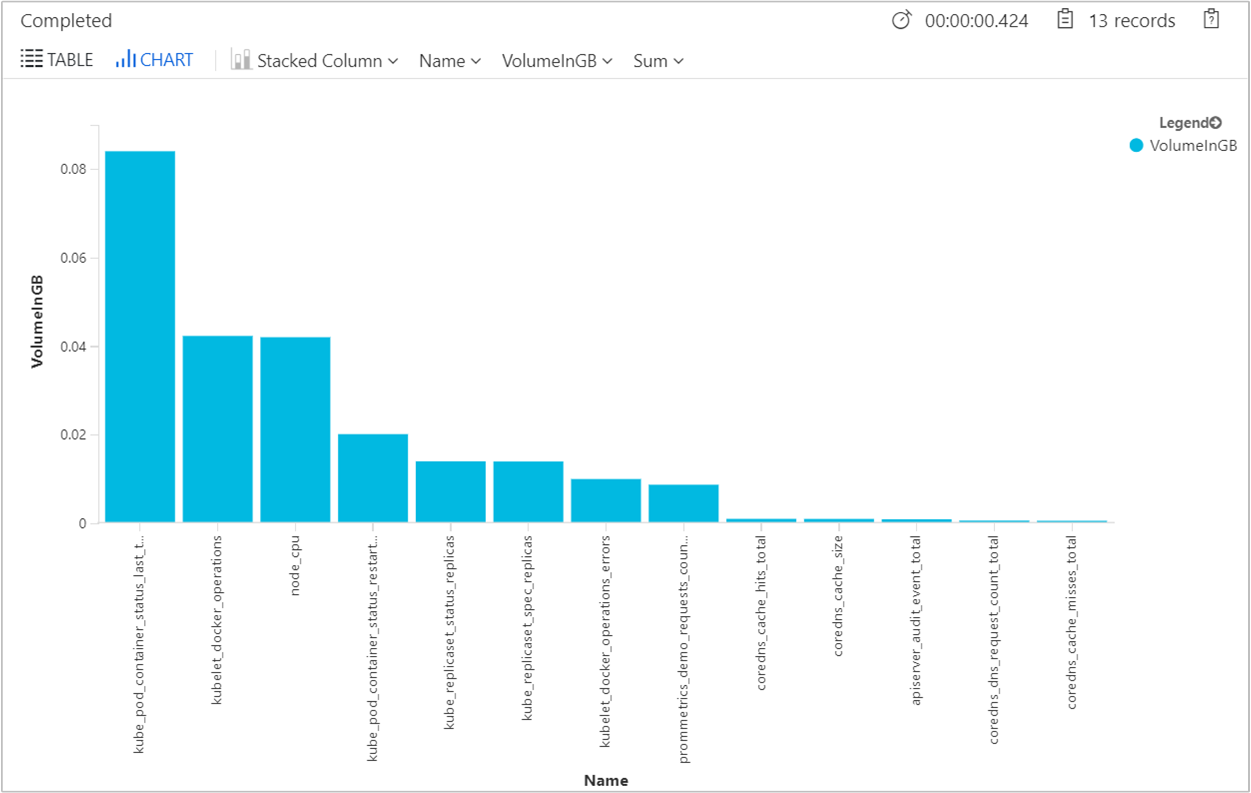
Чтобы оценить размер каждой метрики в ГБ в месяц, чтобы понять, велик ли объем данных, полученных в рабочей области, предоставляется следующий запрос.
InsightsMetrics
| where Namespace contains "prometheus"
| where TimeGenerated > ago(24h)
| summarize EstimatedGBPer30dayMonth = (sum(_BilledSize) / (1024 * 1024 * 1024)) * 30 by Name
| order by EstimatedGBPer30dayMonth desc
| render barchart
Выходные данные будут содержать результаты, аналогичные тем, что приведены в примере ниже.

Ошибки конфигурации или сбора данных
Чтобы проверить наличие ошибок конфигурации или скрейпинга, приведенный ниже пример запроса возвращает информационные события из таблицы KubeMonAgentEvents.
KubeMonAgentEvents | where Level != "Info"
В выходных данных показаны результаты, подобные следующему примеру:
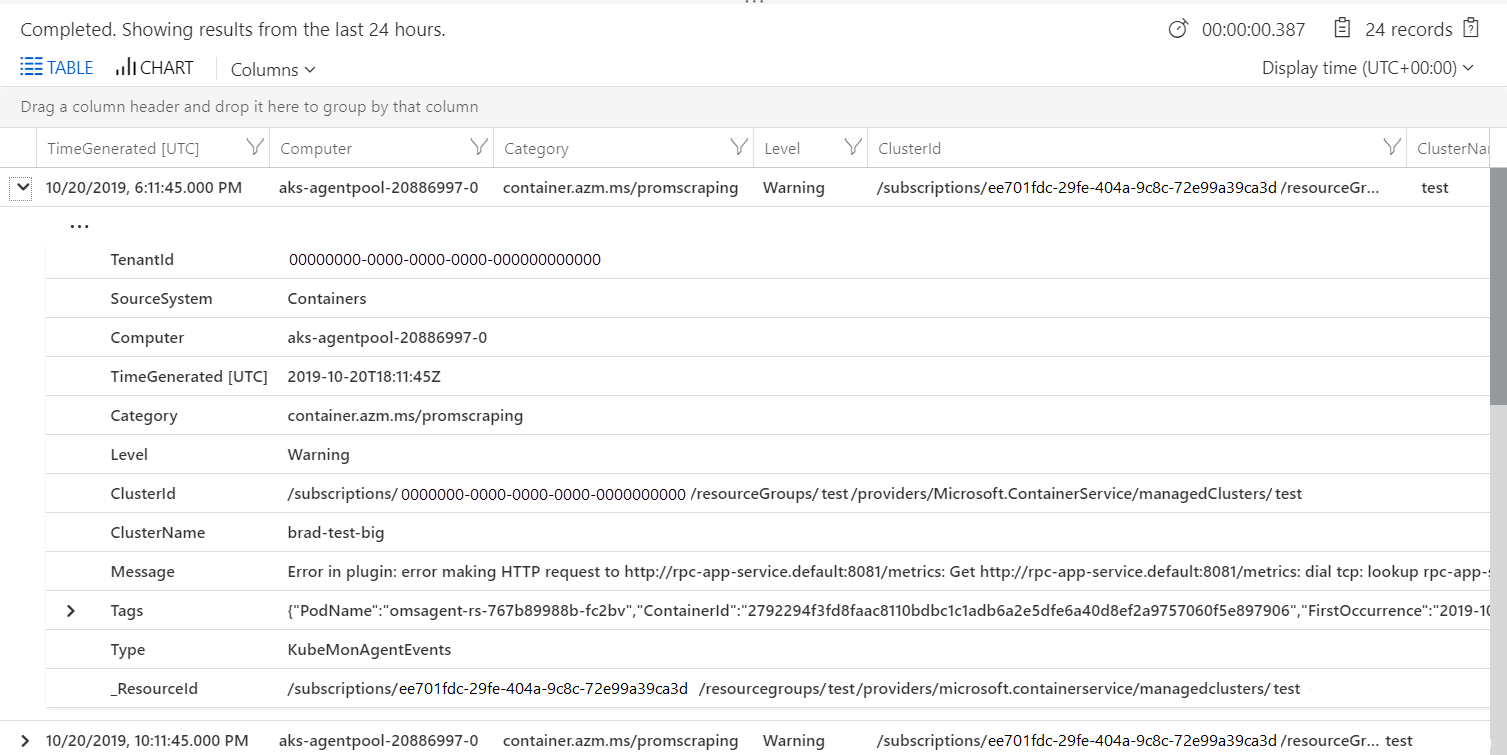
Следующие шаги
Аналитика контейнеров не включает предопределенный набор оповещений. Чтобы узнать, как создавать рекомендуемые оповещения для высокой загрузки ЦП и памяти с целью поддержки DevOps или рабочих процессов и процедур, ознакомьтесь со статьей Создание оповещений о производительности с помощью аналитики контейнеров.